



Table of Contents
- Body Structure: Cat Skeleton and Musculature
- Cats and Their Organs
- Preventing Ailments and Strengthening Health – for a Long, Fulfilling Cat Life
Cats move through life with fascinating lightness
balancing elegantly on fences and roofs, chasing
across fields and meadows at lightning speed, creeping silently up to their prey,
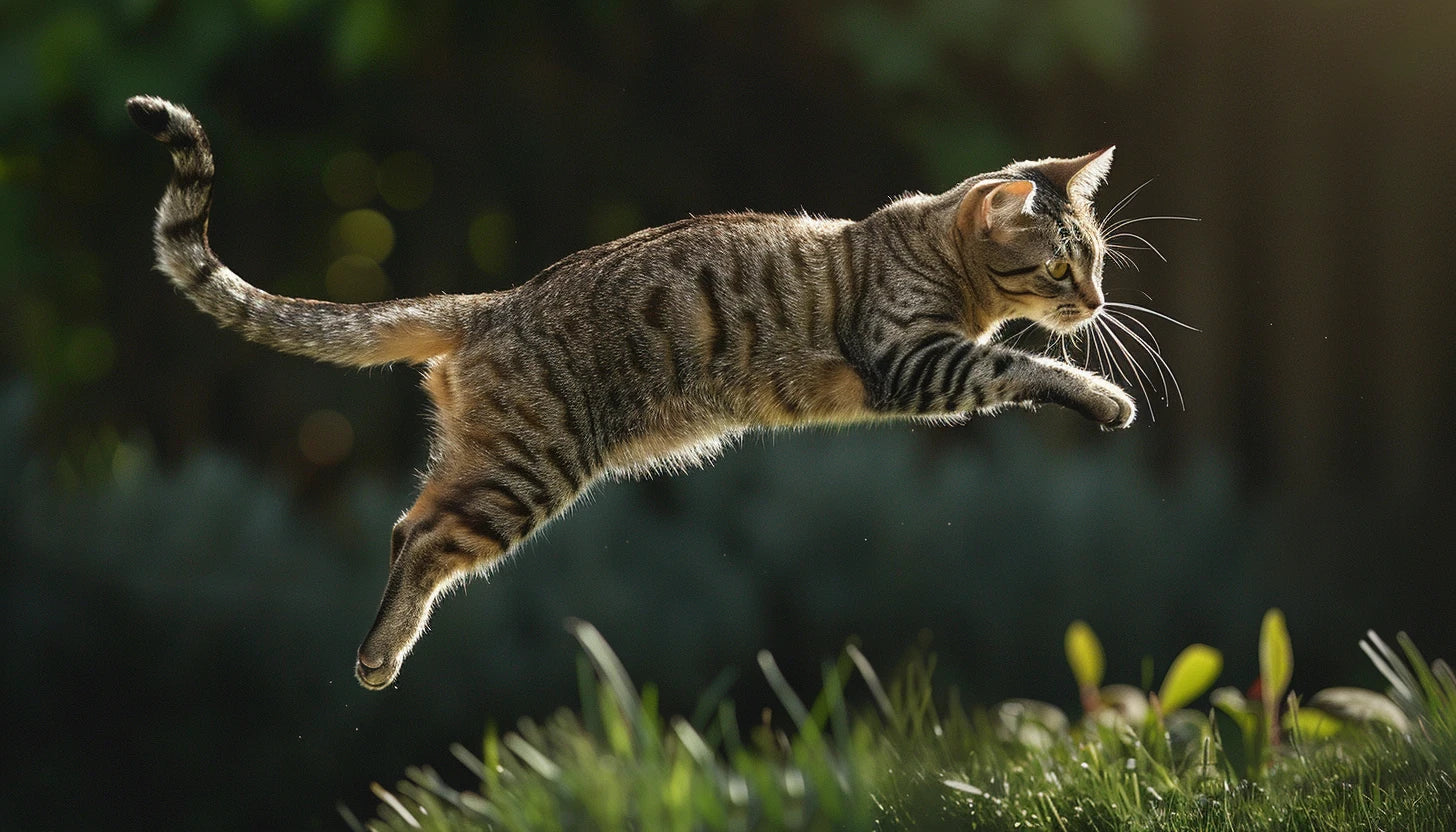
climbing effortlessly to dizzying heights, and always landing safely
and gently on their paws. Cats owe all this to their body structure. We will take a closer look
at the cat's anatomy – from bones and muscles to the
organs, paws, whiskers, and more.
Body Structure: Cat Skeleton and Musculature
Cats are carnivores. In the wild, they must lie in wait, stalk carefully, and chase their prey over long distances if necessary. The cat's body structure is therefore designed for speed and agility: Their bones are light and robust and their skeleton is flexible.
The Structure of the Cat Skeleton
Cats have approximately 240 to 250 bones – and thus around 40 more bones than an adult human. The exact number of bones varies depending on the cat breed. One rule of thumb: the longer the cat's tail, the more bones it has.
The many bones are distributed throughout the cat's body as follows:
- The spine consists of approximately 50 vertebrae – about 20 of which form the cat's tail.
- 13 pairs of ribs extend across the cat's upper body and protect the internal organs.
- The skull of a cat consists of 29 individual bones. Correspondingly, after the tooth change, 30 permanent teeth make up the house cat's bite.
- The front legs consist of one upper arm and forearm bone each, and the hind legs consist of one femur, one shin bone, and one fibula each – thus the cat's hind legs resemble our legs and the front legs our arms.
- The cat's paws are true anatomical masterpieces. They consist of numerous fine bones that can be divided into toe bones, metatarsal/metacarpal bones, and carpal/tarsal bones around the joints. The cat's sharp claws are located on the toes.
Special Features of Cat Anatomy
Cats are known for their supple way of moving – so much so that an elegant, silent gait in humans is also often described as cat-like. The difference: in the animal, these quick, fine movements are anatomically determined – because cats are actually predators. This is ensured by a perfect interplay of approximately 240 bones and 500 freely movable muscles:
- The cat's shoulders, for example, are only loosely connected to the ribs via muscles and tendons – thus the velvet paws remain particularly nimble and can become very narrow or even bend.
- Especially the cat's strong hind legs have pronounced musculature. This allows the animals to run quickly – up to 50 km/h over short distances – and jump extremely high – up to 2 m from a standing start.
- The so-called righting reflex, also known as the cat reflex, enables the cat to turn into an ideal position for it in the air in a matter of seconds. Thus, it usually lands on its paws effortlessly during jumps and falls and skillfully absorbs the force of the impact.
- The cat's tail supports its sense of balance with its around 20 vertebrae and helps it maintain its balance while climbing.
- Cats are digitigrade walkers and can therefore move almost silently. However, they do not use their paws only for walking: Their pads protect them from heat and cold and perceive even the finest vibrations through receptors. With their claws they catch their prey and defend themselves against natural enemies and intruders. Even fine motor movements are no problem for the flexible cat paw.
Cats and Their Organs
The cat's skeleton not only helps it with its flexibility and suppleness, but above all serves to protect the internal organs. These include:
- the cardiovascular system with the cat's heart and the blood vessels that transport oxygen and nutrients through the cat's body
- the digestive tract, which besides the cat's stomach and intestines includes other organs such as the liver, pancreas, gallbladder, and esophagus, and works closely with the teeth and salivary glands in the cat's mouth
- the respiratory system consisting of the lungs, bronchi, trachea, larynx, as well as the cat's mouth, nose, and throat
- the reproductive and urinary organs, i.e., the kidneys as well as the bladder, urethra, and ureters
- the thyroid gland, which together with other organs is responsible for the cat's hormonal balance
- the spleen, thymus, bone marrow, and lymph nodes and vessels, which together form the immune system and are responsible for the production of blood cells and platelets
The Cat's Sensory Organs
While the internal organs are enveloped and protected by the skeleton, skin, and warming fur, the sensory organs on the cat's head help the velvet paw with orientation, communication, and feeding.
Attentive Cat Ears
With their ears, cats pick up sound waves – through the slightest movements of the pinna, they manage to attentively perceive even quiet sounds that are barely audible to us. Sensory cells and nerves in the inner ear also strengthen the cat's sense of balance and help it orient itself in its surroundings.
Pronounced Sense of Sight – Even in the Dark
The sense of sight is particularly pronounced in cats: Thanks to their slit-shaped pupils, cat eyes are able to focus light optimally. This allows cats to see crystal clear even in low light and not be blinded by strong light – perfect for finding their way in the dark and going on the hunt. Although their eyes can perceive significantly fewer colors than ours, for example, they have a much wider field of vision.
Smelling, Tasting, and Flehmen
The cat's sense of smell is also very sensitive: The first contact with fellow cats, other four-legged animals, and also us humans usually takes place by sniffing. Cats recognize their loved ones first by their body odor and store memories primarily through smells. This is how they recognize their territory and know where they can feel safe.
In addition to the nose, velvet paws also use the so-called Jacobson's organ between their palate and nostrils for smelling – or more precisely, for flehmen. Through this special mixture of smelling and tasting, cats and other mammals perceive smells even more intensely and communicate in a unique way – for example with sexually mature conspecifics. At the same time, the Jacobson's organ is also responsible for the sense of taste.
The Tongue as a Multitool
The cat's rough tongue is a sensory organ and a tool in one: With its papillae, which act like tiny hooks, the cat's tongue is perfectly suited to keep the fur clean and free it from knots and parasites. It also plays a central role in feeding and helps cats regulate their body temperature by licking.
Whiskers – Sensitive Tactile Organ
Whiskers give the cat its cute appearance, but they also fulfill a much more important role: They help the animal orient itself in its surroundings. The hairs known as vibrissae are largely responsible for the cat's sense of touch. They perceive subtle air movements, vibrations, and pressure changes. This allows cats to estimate distances more accurately, detect dangers that their eyes cannot perceive due to the short distance, and assess how best to catch their prey.
Preventing Ailments and Strengthening Health – for a Long, Fulfilling Cat Life
Cats are delicate, sensitive animals with a highly complex anatomy that is optimally adapted to their agile, curious nature and natural hunting instinct. In addition to species-appropriate care with sufficient play, exercise, and climbing opportunities, velvet paws above all need a balanced diet to enjoy a long, fulfilling, and healthy life.
A varied mixture of wet food, dry food, sufficient water, and if necessary, snacks and drinks for more enjoyment in eating ensures that your cat is supplied with all the important nutrients and vitamins and takes in enough fluid. In addition to the quality of the food, the balance, the energy content, and the right amount also play a major role in your cat's health and well-being.
Especially with indoor cats, who often move around less in everyday life than outdoor cats, overweight poses a serious risk to the cat's overall health. Overweight accelerates the wear and tear of the joints, can lead to porous bones, and significantly restricts the mobility and agility of cats – and thus their quality of life.
KATTOVIT Indoor Wet Food is specially tailored to the particular needs of indoor cats. A low-calorie, high-protein recipe and easily digestible ingredients help to reduce or prevent overweight in house cats. For species-appropriate nutrition – and a carefree cat life.
[indoor+wellnessbox]