









FORL (Feline Odontoclastic Resorptive Lesions) is one of the most common and painful dental diseases in cats. Many feline friends suffer from it unnoticed for a long time because the symptoms are often non-specific. The disease gradually destroys tooth substance and can lead to severe pain. Without treatment, the condition steadily worsens and causes further pain. Here you will learn exactly what FORL is, what its causes and risk factors are, how the disease is detected and treated, and how you can enable your cat to live a pain-free life.
Table of contents
- What is FORL in cats?
- Causes and risk factors
- Symptoms of FORL in cats
- Diagnosis – how the vet detects FORL
- Treatment options
- Prevention: Can FORL be prevented?
- FAQ – Frequently asked questions
What is FORL in cats?
FORL stands for Feline Odontoclastic Resorptive Lesions. It is a progressive dental disease in which the body's own cells – so-called odontoclasts – break down tooth substance. The process often begins unnoticed in the area of the tooth neck and spreads over time to the tooth crown and tooth root. The affected teeth become unstable and can break or be lost entirely.
The disease is widespread in cats and can affect animals of any age. It occurs particularly frequently in older cats – but almost every second cat is affected by the age of five.
FORL can affect a single tooth, several teeth, or in severe cases, the entire dentition. For affected animals, this often means constant pain, even if most cats do not show it at first.
It is typical for FORL that the changes are not visible at the beginning. Only in advanced stages do clear damages appear, such as holes in the tooth substance or chipping of the tooth crown. Since cats are good at hiding pain, many cat owners do not notice the disease until the animal changes its eating behavior or shows other abnormalities.
FORL is divided into two main types, which differ in their progression and their effects on the tooth. For successful treatment, it is important to know which form the cat is suffering from:
- Type 1: In FORL Type 1, the breakdown of tooth substance usually occurs due to inflammation of the periodontium. The tooth roots are gradually dissolved and inflammatory tissue grows in. In this form, affected teeth, including the roots, must be completely removed to eliminate the pain permanently.
- Type 2: In FORL Type 2, the tooth root is not only broken down but also replaced by bone-like tissue. This process usually occurs gradually and without severe inflammation. In an X-ray, the root structure appears blurred or is no longer visible at all. In such cases, it may be sufficient to remove only the visible part of the tooth.
Causes and risk factors
The development of FORL has not yet been fully researched. However, it is certain that the disease involves the activation of the body's own cells, the so-called odontoclasts. These cells normally break down milk teeth in young animals. In an affected cat, however, they begin to destroy permanent teeth as well.
Why this process occurs has not yet been clearly determined. Various factors can play a role:
- Plaque and tartar: Deposits on the teeth promote inflammation in the periodontium. This inflammation can stimulate the activity of odontoclasts.
- Inflammation and diseases of the gums: Chronic gingivitis weakens the tissue and can promote the breakdown of tooth substance.
- Genetic predisposition: In some cats, hereditary factors appear to increase the risk of FORL.
- Nutrition: Certain types of food or nutrient deficiencies, such as a low calcium or magnesium content, are suspected of promoting development.
- Age: As a cat gets older, the likelihood of developing FORL increases.
Symptoms of FORL in cats
FORL is often unnoticed at the beginning because cats are good at hiding pain. Early signs are therefore usually non-specific and can be easily confused with other problems. As the disease progresses, however, the symptoms become more apparent.
Typical signs of FORL include:
- Changes in eating: The cat chews more slowly, drops food, rejects cold food, suddenly only eats soft food, or refuses food entirely.
- Gingivitis: Redness or swelling of the gums can be an indication of an incipient resorptive lesion.
- Visible holes or defects on the teeth: Small, round defects can occur, especially in the area of the tooth neck.
- Increased drooling: Some cats drool more if a tooth is painful.
- Defensive reactions when touching the mouth: Touching the head or mouth area can be felt as unpleasant or painful.
- Behavioral changes: Withdrawal, apathy, or irritability can result from chronic pain.
Since these symptoms can also occur with other dental diseases or general health problems, a veterinary diagnosis is important. This is the only way to determine if FORL is the cause.
Diagnosis – how the vet detects FORL
Diagnosing FORL is often a challenge because early changes to the teeth are not visible from the outside. Even with a thorough examination while the cat is awake, many lesions remain undetected.
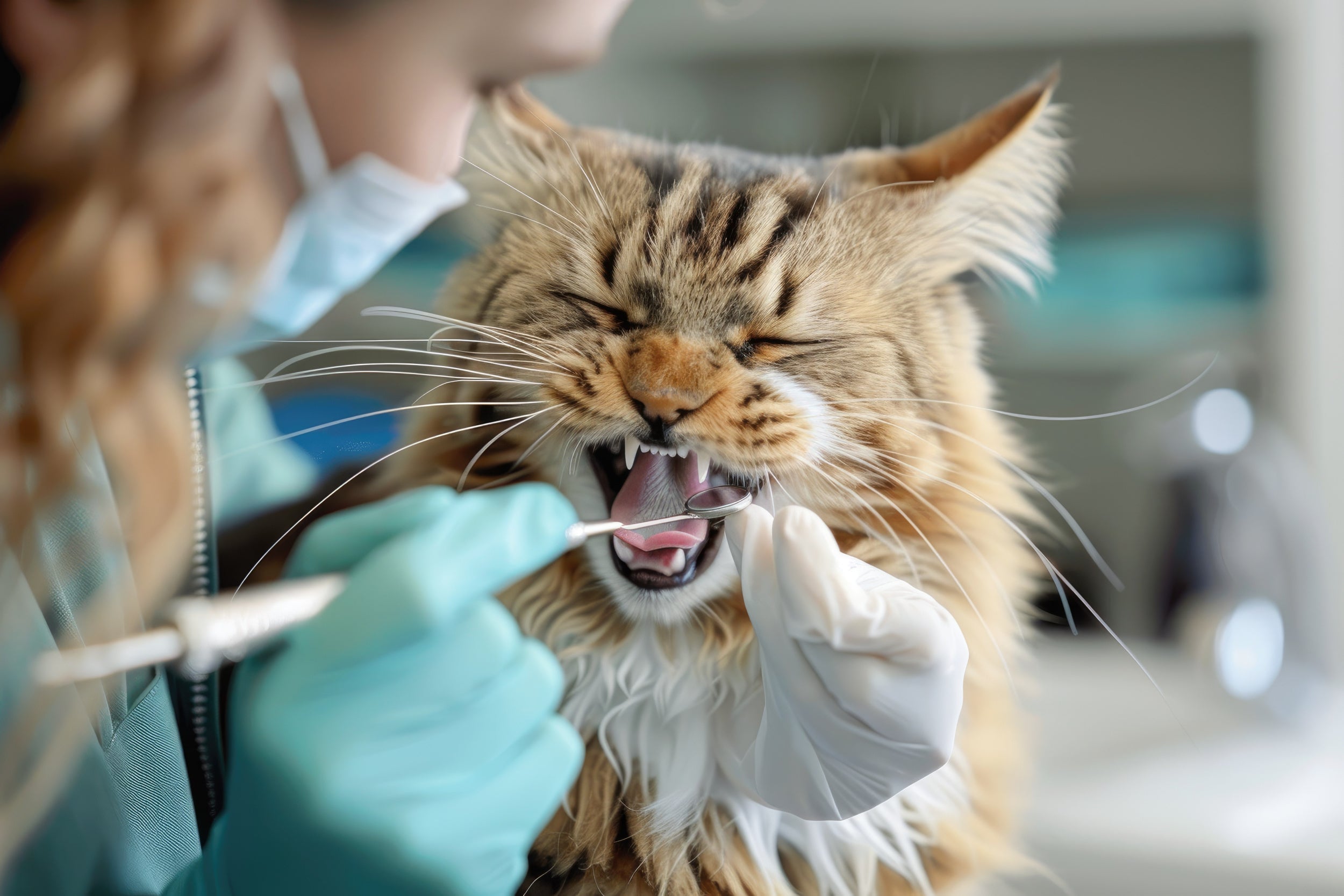
- The first step is usually a clinical examination of the mouth. The veterinarian looks for visible defects in the teeth, redness or swelling of the gums, and signs of pain. Suspicious areas may indicate a FORL condition, but they are not sufficient for a definitive diagnosis.
- To obtain certainty, the veterinarian performs dental X-rays. The cat's teeth are X-rayed – usually under anesthesia. This is the only way to identify changes to the tooth root or under the gums. FORL lesions often show up on the X-ray as dissolution of the tooth structure or as the replacement of the root with bone-like tissue.
- Additionally, the veterinarian can check the condition of the periodontium and assess whether other teeth are affected. Since FORL usually affects several teeth at the same time, all teeth are frequently X-rayed. Based on this, targeted treatment can then take place.
Treatment options
A cure for FORL is not currently possible. Treatment therefore aims to remove the affected teeth and thus eliminate the tooth pain.
The most common and effective treatment is the complete removal of the affected teeth. With Type 1 FORL, the tooth including the root must be removed because it is still present and often inflamed. With Type 2 FORL, the root may already have been replaced by bone tissue. In such cases, it is often sufficient to remove only the visible part of the tooth.
The surgery is performed under general anesthesia. First, a dental X-ray is carried out to assess the condition of each individual tooth. Subsequently, the veterinarian removes the affected teeth and tooth roots using special dental surgical instruments. The wound is sutured to promote rapid healing.
After the procedure, the cat receives painkillers and, if necessary, antibiotics. In the first few days after surgery, the cat should only receive soft food so as not to jeopardize wound healing. The veterinarian checks after the surgery whether the wounds are healing well and may verify through a follow-up X-ray that no other teeth are affected.
Prevention: Can FORL be prevented?
Since the exact causes of FORL are not yet fully understood, there is no reliable method to prevent the disease. Nevertheless, cat owners can do something to reduce the risk:
- Regular brushing can help reduce plaque and tartar. However, most cats do not simply accept having their teeth brushed. It can help to get the animal used to the toothbrush playfully as a kitten.
- Have tartar removed regularly.
- Pay attention to changes in your cat's eating behavior – these can be an indication of tooth pain.
- Always have gingivitis treated by a veterinarian.
- Have the cat's dental status assessed regularly by the veterinarian.