








Table of Contents
- The ideal feeding frequency: How often should I feed my cat?
- Dry food or wet food – which is better?
- How much food does my cat need?
- Tips for feeding your cat
- FAQ – Frequently asked questions
The ideal feeding frequency: How often should I feed my cat?
In general, cats prefer several small meals spread throughout the day. This is because in the wild, these feline hunters catch several mice, birds, or other prey depending on the opportunity, amounting to 10 to 20 small meals per day rather than a few large ones. Accordingly, a cat's stomach is designed more for smaller portions. How often you should give your cat fresh food per day depends on the age and health status of your cat:
- Kittens need food particularly often. Their energy requirements are high because they are still growing. They should be given four to five small meals a day. It is important that the food is specially suited for young animals so that it contains sufficient energy and all the essential nutrients for the growing felines. For kittens, you should also ensure that you offer different types of feed and varieties from different brands. Otherwise, it may happen that the young kitten gets very used to its food and refuses to accept anything else later.
- Adult cats usually get by with two to three meals a day. You can feed them in the morning and evening, or spread the daily ration into smaller portions. Some cat owners use automatic feeders for this purpose, which provide food at set times.
- Senior cats often have lower energy requirements but require easily digestible food. Here, too, two to three meals are reasonable. Ensure that your feline can easily consume and chew the food.
- Pregnant or sick cats have special needs. Their energy requirement is generally higher, which is why they need more food more frequently. In these cases, it is advisable to consult a veterinarian to coordinate the optimal feeding amount and type.
- Neutered animals have a lower energy requirement but are often particularly hungry. With neutered cats, however, you should not simply reduce the amount of food to avoid obesity. Instead, you should use food that is calorie-reduced but still satisfying and contains all necessary nutrients.
Dry food or wet food – which is better?
Many cat owners wonder whether they should offer their cat dry food, wet food, or a combination of both. Both options have their own advantages and disadvantages:
Advantages and disadvantages of dry food
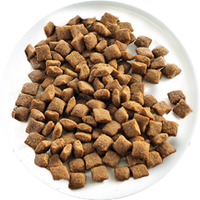
Dry food is primarily practical: it has a long shelf life, is easy to store, and can stay in the bowl without spoiling quickly. This is particularly helpful if you cannot feed your cat at set times or use automatic feeders. Another advantage: by chewing the hard kibble, dry food can help to reduce plaque.
However, dry food has a very low water content. Cats often drink too little by nature because they usually cover their fluid requirements through their food. If your cat eats a lot of dry food, it must therefore be ensured that it always has enough fresh water available.
Advantages and disadvantages of wet food
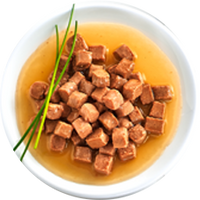
Wet food, on the other hand, contains a high proportion of moisture – often up to 80%. This helps you to ensure sufficient fluid intake and also supports kidney function.
Furthermore, wet food usually has a more intense smell and taste, which makes it more attractive to many cats. Older animals or cats with dental problems in particular often cope better with wet food.
The disadvantage: It spoils faster if it stays in the bowl for too long and should therefore always be served fresh.
Combination feeding: Combining wet and dry food
Combination feeding connects the advantages of both wet and dry food. You can, for example, give wet food in the morning and dry food in the evening or vice versa.
It is important that you keep an eye on the total amount of food and do not feed the full amount of both types, otherwise the calorie intake will rise quickly. Make sure to adjust the portions of the respective food type so that the total daily ration remains correct.
How much food does my cat need?
The correct amount of food depends on several factors: your cat's age and weight, activity level, and health status. There is no one-size-fits-all recommendation, but with a few basic rules, you can estimate the appropriate amount well.
As a rough guideline: a normal-weight adult cat requires about 50 to 70 kilocalories (kcal) per kilogram (kg) of body weight per day. This means a 5 kg cat needs about 250 to 350 kcal daily.
Active outdoor cats have a higher energy requirement, while indoor cats often consume less energy and therefore do well with smaller portions.
Indoor cats move less and tend to become overweight more quickly. Here, it is important to measure the daily ration precisely and be economical with snacks and treats. Outdoor cats consume more energy through their travels outside and are allowed to eat a bit more. Nevertheless, you should also check their weight regularly.
Recommended daily rations by weight
|
Cat's weight |
Wet food per day |
Dry food per day |
|
2 kg |
approx. 160-200 g |
approx. 20-40 g |
|
3 kg |
approx. 200-250 g |
approx. 30-60 g |
|
4 kg |
approx. 250-300 g |
approx. 35-70 g |
|
5 kg |
approx. 290-340 g |
approx. 40-85 g |
|
6 kg |
approx. 330-380 g |
approx. 50-95 g |
Important: These values are guidelines and can vary depending on your cat's age, activity, and health. Additionally, you will find feeding recommendations on every cat food package, which you can follow initially.
Depending on whether your cat gains or loses weight, you can adjust the food amount accordingly. If you are unsure, your vet will help you determine the correct amount.
Tips for feeding your cat
With a few tips, you can better organize your cat's feeding to ensure more health and satisfaction for your feline friend:
- Automatic feeder and bowl: If you are not always home at set times, an automatic feeder can be a good solution. It dispenses a specific amount of food at previously set times. This helps to distribute the daily ration evenly. Important: Ensure that the bowl is always clean so that no food residue accumulates.
- Establish regular feeding times: Regardless of how many portions of food your feline gets per day, you should feed the animal at consistent times if possible, so it can adjust to them. This avoids stress and begging at the table.
- Food games and activity ideas: Cats are hunters by nature. Instead of just putting the food in the bowl, you can make feeding more exciting by using food games in between. There are special puzzle boards or food balls into which you can fill dry food. This way, your cat has to "work" for its food, stays mentally sharp, and moves more.
- Don't forget drinking water: Especially with dry food, it is important that your cat drinks enough. Place several water bowls in the apartment – preferably some distance away from the food bowl. Many cats prefer to drink from running water, which is why a drinking fountain can also be a good idea.
- Avoid obesity: A common problem in indoor cats is obesity. It often occurs because too many snacks or portions of cat food are given. Be sure to measure the daily ration precisely – and subtract snacks and treats from the daily ration. Weigh your cat regularly and adjust the food amount if the weight increases.
- Incorrect food types: Not every food is suitable for every cat. Young cats, pregnant animals, or seniors have different needs than healthy adult cats. Special food is also useful for illnesses, food allergies, or gastrointestinal problems. Here, for example, the KATTOVIT Gastro range, developed for sensitive cats, can help. You can find a large selection of special dietary food for cats with special needs in our shop.