









Is your cat grooming itself constantly and more frequently than usual? Cats are very clean animals, and their daily grooming takes up a lot of time. However, if your cat is grooming itself unusually often and intensely, there could be an underlying health problem behind this behavior. Find out here which diseases and ailments can lead your cat to groom its fur too intensely and what you can do about it.
Table of Contents
- Cat Grooming
- Causes of Excessive Grooming
- Why does a cat groom itself too little?
- Grooming behavior as a health indicator
- FAQ – frequently asked questions
Cat Grooming
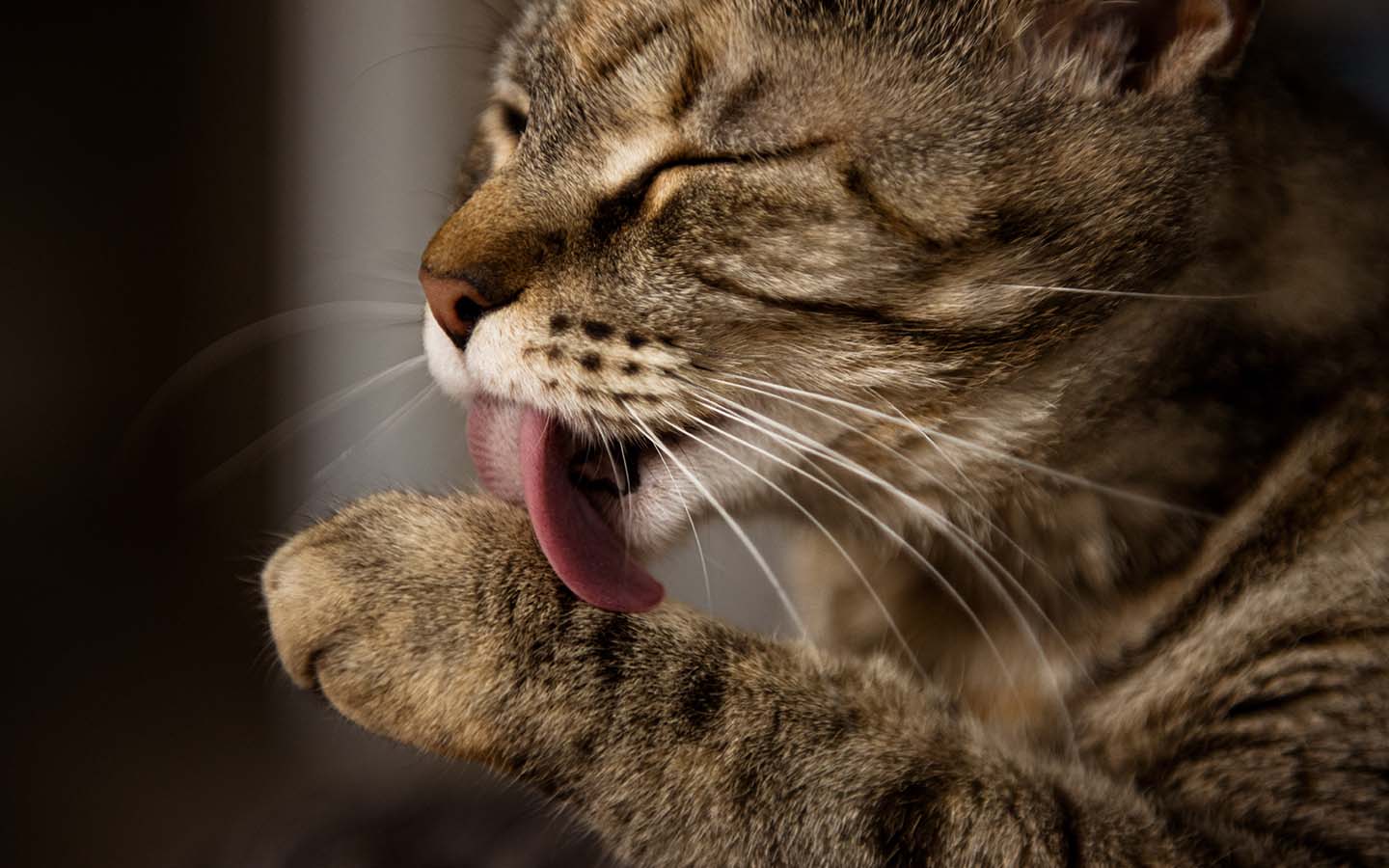
Cats take their grooming very seriously and spend an average of more than three hours a day cleaning their fur. This serves several purposes:
- Cleaning
- Cooling down
- Waterproofing
- Creating a scent mark
- Reducing tension
To successfully clean their fur, cats have small barbs on their tongues. These allow them to easily remove dust, dirt, and loose hair while licking. In the summer months, grooming can take up even more time than usual because the animals cool themselves down during extreme heat by grooming. Since they have few sweat glands and do not primarily use them for temperature regulation, wetting their fur with saliva provides pleasant cooling through evaporative heat loss.
Furthermore, licking the skin stimulates blood circulation, which activates the sebaceous glands in the skin. These glands, in turn, release oil into the cat's fur. This thin layer of oil ensures that the cat's fur remains supple and water-repellent. This protects the animals better against moisture and cold.
Another side effect of grooming with their own saliva is the creation of an individual scent. This allows cats to successfully mark their territory and be perceived by other cats from a distance. Since licking the fur stimulates circulation, grooming also serves to reduce tension. If cats feel stressed, tense, or embarrassed, grooming can be a type of displacement activity that helps unpleasant feelings fade away. Such a situation arises, for example, when a cat watches a bird or other prey through the window but is unable to hunt, leading it to start grooming. Grooming serves many purposes for cats, so it is hardly surprising that the animals spend a lot of time on it. But what could be the reason if your cat is suddenly grooming much more frequently and intensely than usual?
[Sensitive+Renal]
Causes of Excessive Grooming
If you notice that your feline friend is spending an unusual amount of time grooming and perhaps behaving conspicuously, health issues or other problems might be behind this so-called "overgrooming."
Parasite Infestation
If your cat is repeatedly licking the same spots and seems restless, nervous, or irritated, a parasite infestation could be the cause. This is often accompanied by scratching and biting of the affected skin area. Potential parasites include those that settle on the skin and in the fur, such as fleas, lice, ticks, or mites. However, worms can also cause itching on the skin and lead your feline to repeatedly lick the affected area. For this reason, you should deworm your cat regularly.
Mites are often only discovered when brown crusts have developed on the cat's ears and forehead. Therefore, you should regularly examine the fur for unwanted guests, especially in outdoor cats, and remove ticks promptly. A fungal infection can also cause your cat to groom constantly. A skin fungus causes itching, shaggy fur, and potentially even circular hair loss.
If you suspect a parasite infestation, place your cat on a white surface, such as a paper towel, and comb through its fur. Tiny red dots could be flea feces, for example. You should also regularly check the fur and skin for rashes and bite wounds. To identify and adequately treat a parasite infestation as early as possible, it is best to visit your vet at the first sign.
Injury
Increased licking of a specific body part can also be attributed to an injury. Outdoor cats are frequently involved in territorial fights with other cats. However, an accident outdoors or inside the house can also be responsible for injuries. You should therefore examine your cat at regular intervals for wounds or bruises that require treatment by a veterinarian.
Allergy
Your cat's intensified grooming behavior can also be due to a food allergy or an intolerance. An allergic reaction to food often causes unpleasant skin rashes, itching, and swelling. Affected cats often also suffer from other symptoms such as diarrhea, vomiting, and loss of appetite. Be sure to consult a vet here as well. In most cases, switching to hypoallergenic special diet food, which allows for an elimination diet with reduced ingredients, provides relief and is gentle on your cat's stomach.
Illness
The fact that your cat is constantly grooming itself and licking its fur can, however, also indicate a serious illness. For example, pain could be the reason why the animal will not leave a certain part of its body alone. Or the increased grooming behavior serves to reduce the tension triggered by physical discomfort and to distract itself.
In most cases, illnesses are accompanied by other symptoms that can help narrow down the cause. Tiredness and loss of appetite are typical signs that something is wrong. If vomiting and diarrhea occur in addition to your cat's constant grooming, a gastrointestinal problem may be present. A kidney disease, on the other hand, can cause symptoms such as flaky skin and resulting itching, and may manifest through increased thirst and frequent urination. Struvite stones, in turn, can prompt your feline to lick its genital area frequently and can also cause tiredness, diarrhea, and abnormal behavior when urinating.
The list of possible illnesses that can lie behind your cat's increased grooming is long. It is important that you observe your pet's behavior carefully and pay attention to whether other symptoms occur. If your four-legged friend behaves unusually or it is evident that it is not doing well, you should have it examined by a veterinarian. This is recommended for cat owners at regular intervals anyway – especially against the backdrop that cats usually hide their suffering for a long time and do not let anything show at first.
Stress
Has your cat's grooming behavior taken on compulsive traits, but neither you nor the veterinarian can detect any other symptoms or causes? Then stress might be behind the overgrooming. As already mentioned, grooming the fur also serves to stimulate blood circulation and reduce tension. Your feline can therefore call upon this practiced mechanism again and again when it is nervous, stressed, or uncomfortable.
The triggers for stress are manifold. Often, major changes are associated with stress for cats: these include moving houses, new animal or human roommates, or the loss of other cats or a beloved owner. Even supposedly small changes, such as moving furniture around or the cat owners being away for longer periods daily, can increase the animals' stress levels.
In the worst case, increased grooming can escalate into a compulsive disorder, so-called psychogenic alopecia. In this case, the cat licks itself so intensely that it gradually pulls out all its hair with its tongue, leaving behind bald patches.
Therefore, check whether a major change might be responsible for your cat grooming itself constantly. If possible, try to eliminate sources of stress or make the adjustment to new circumstances as easy as possible for your cat by providing plenty of affection and suitable retreats.
If there is indeed compulsive alopecia that persists even after the removal of stress triggers, you should consult your veterinarian about a suitable therapy.
Why does a cat groom itself too little?
In addition to intensified grooming, the opposite case is also conceivable: your cat neglects its grooming and its fur appears lusterless and shaggy. Dull and matted fur does not necessarily mean that your cat has stopped grooming itself. A nutrient deficiency – for example due to inferior food – can also make the hair look lusterless. Furthermore, parasites or various organic diseases can be behind shaggy fur.
If you actually notice that your cat is no longer grooming itself sufficiently, it may be because it is in pain and therefore avoids touching certain parts of its body. On the other hand, it is possible that old or overweight cats in particular can no longer reach all parts of their bodies with their tongues. In these cases, you can support your cat in its grooming by brushing its fur.
Grooming behavior as a health indicator
Your cat's grooming behavior can therefore give you a great deal of insight into whether it is healthy or if something is wrong. Cat owners should always observe their animals and know their typical behaviors. If changes then occur – for example, if the cat is constantly grooming itself or, alternatively, is not grooming enough – you can react quickly and clarify possible causes.
Regular examination of your cat's fur and skin also contributes to identifying problems such as injuries and parasites quickly and treating them effectively. When in doubt, you should always consult a veterinarian and get professional advice. Depending on the diagnosis, specialized food formulated for cats' health conditions and rich in nutrients can contribute to your cat feeling better again quickly.