









Similar to humans, cats require saliva to maintain certain bodily functions and thereby satisfy natural needs. Saliva, for instance, performs a central function in the intake of food, as well as in body hygiene. If you notice increased salivation in your cat, you should therefore take a closer look and get to the bottom of the drooling – because the potential causes range from harmless physical reactions to serious illnesses.
Table of Contents
- Salivating and drooling in cats: What is normal?
- Searching for causes: Why do cats drool?
- My cat is drooling – what can I do?
Salivating and drooling in cats: What is normal?
Cats produce saliva to chew and swallow their food more easily, to clean and moisten their teeth and oral cavity, and to groom their fur – for which cats use their tongues. Saliva production is therefore important and, provided it occurs in a healthy amount, completely normal. But how much is normal? And where does the "healthy amount" end?
Usually, most of the saliva stays where it is produced and needed – namely, in the mouth. This changes when cats drool: in this case, saliva escapes and drips or runs down the side of the mouth. This does not happen without reason – at least in most cases. The potential causes for salivation range from harmless physical reactions to serious illnesses.
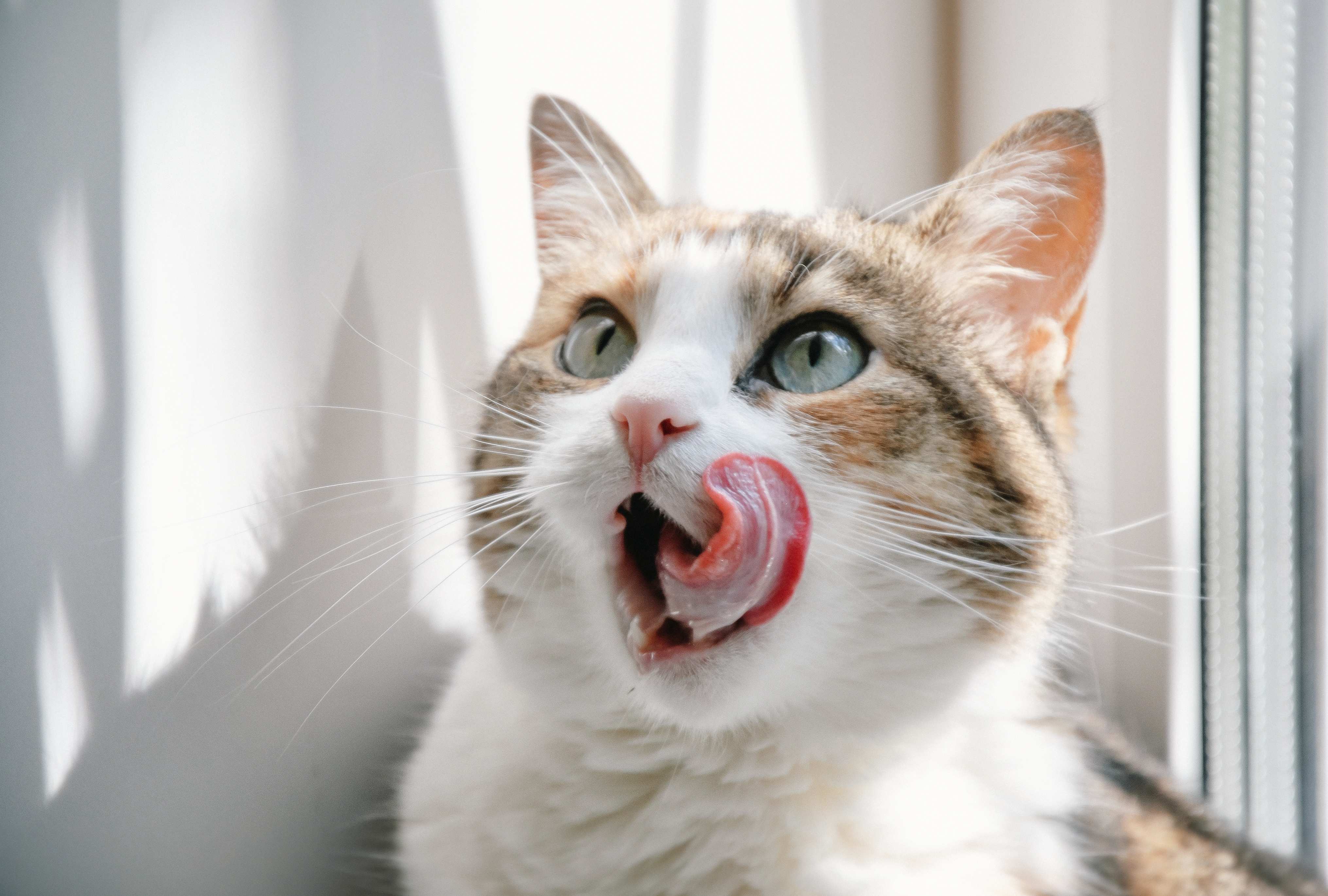
Some cats, for example, drool when they are happy, relaxed, or excited – this can happen when they are being petted, cuddled, and played with, and last but not least, when they see a delicious meal. Sometimes the mere thought of food – or an eventful dream – is enough. Therefore, drooling during sleep can certainly occur in cats. In these situations, it is usually a completely harmless physical phenomenon that requires no treatment.
Searching for causes: Why do cats drool?
When cats drool, there can be a wide variety of causes behind it. We take a look at the most common triggers for heavy salivation in cats.
Harmless explanations for salivation
As mentioned, some animals – including some cats – drool when they are relaxed, anticipating something, or have an appetite. Stroking, cuddling, purring, upcoming or recent meals, and similar scenarios are undoubtedly among the harmless causes. Furthermore, other explanations for suddenly occurring drooling are possible, which are also harmless:
- Catnip and valerian are very popular with cats. The scent of these substances attracts the animals and has a calming or even intoxicating effect on many feline friends – but it can also stimulate saliva production and thus lead to drooling.
- Some medications also lead to noticeably pronounced salivation after intake. This is especially the case with bitter antibiotics. The drooling usually ends on its own and should not be interpreted as a sign of intolerance.
- After an operation or a procedure involving local anesthesia or general anesthesia, it can happen that cats drool. The salivation regulates itself when the anesthesia wears off and any potential impairments associated with the operation subside.
Serious causes for drooling in cats
If your cat's drooling persists over a longer period or occurs repeatedly, it may be due to an illness or inflammation – in this case, it is advisable to look out for further symptoms and consult a veterinarian. In such cases, one speaks of so-called hypersalivation: that is, excessive salivation.
Hypersalivation can occur either because the cat is producing too much saliva, or because existing saliva cannot be swallowed. Both are problematic in that they are unfortunately often interpreted as a symptom of illness and are, above all, bothersome for the affected cat.
The potential causes of hypersalivation are diverse and range from foreign bodies, swellings, and tumors to inflammation, injuries, and poisoning, as well as overheating or chronic diseases and organ failure.
Diseases of the teeth and oral cavity
If cats are drooling heavily, an inflammation or disease in the area of the mouth or teeth is a likely cause. Various conditions come into consideration here:
- Gingivitis is usually triggered by bacteria or viruses but can also occur genetically. It manifests itself through highly reddened, swollen mucous membranes and can lead to increased saliva discharge.
- An inflammation of the oral mucosa, also known as stomatitis, is very similar to gingivitis in terms of development and symptoms and can also manifest itself through heavy drooling, sometimes even with blood.
- One of the most common dental diseases in cats is FORL, short for Feline Odontoclastic Resorptive Lesion. This is a painful condition where calcium is broken down, causing the tooth and its roots to gradually dissolve. FORL often leads to heavy salivation, gingivitis, and tartar.
In the case of inflammation and diseases in the oral cavity, other symptoms can often be observed: for example, halitosis (bad breath), redness and swelling, loss of appetite and changed eating behavior, difficulty swallowing, a noticeable head tilt and jaw position, head shaking, and much more.
Foreign bodies, tumors, and ulcers in the oral cavity
In addition to diseases of the teeth, jaw, or oral cavity in general, foreign bodies or swellings in the mouth area can also be responsible for cats drooling. The accompanying symptoms are often similar.
- If, for example, a piece of string or a blade of grass gets caught in the cat's mouth, it tries to get rid of the foreign body with the help of saliva. If this is unsuccessful, it can lead to purulent and painful inflammation. Affected cats often also refuse to eat and vomit.
- Ulcers in the cat's oral cavity can be attributed to various causes. Perhaps it is a tumor, but an infection could also be the cause. Feline Calicivirus, for example, can cause ulcers in the area of the lips and palate. Allergies can also lead to swelling under certain circumstances.
Drooling as a sign of poisoning
It is also quite possible that cats begin to drool as a result of poisoning. By stimulating saliva production, the body attempts to get rid of the toxin. Potential culprits include houseplants that are completely harmless to us humans but toxic and thus dangerous for cats. Poisoning often manifests itself through thick mucus escaping from the cat's mouth. Depending on the severity, other symptoms may occur, including vomiting, diarrhea, or even signs of paralysis.
Colds and respiratory tract diseases
In addition to coughing, difficulty swallowing, nasal discharge, sneezing, and possibly loss of appetite and lethargy, increased drooling can also occur as a symptom of a cold in cats. If the symptoms point to a cold or respiratory disease, you should definitely find out if your cat might be suffering from cat flu. This viral, highly contagious disease of the mucous membranes and respiratory tract spreads quickly among cats and, if left untreated, can, in the worst case, be fatal. Therefore, a visit to the veterinarian is essential if you suspect cat flu.
Other causes: Diseases, stress, and more
It is not always easy to identify the cause of hypersalivation – for example, when the accompanying symptoms do not provide a clear picture or the search for an obvious reason leads nowhere. Then it is worth considering other triggers.
A disease does not necessarily have to be the reason for your cat's suddenly increased salivation. Instead, stress can also cause cats to drool – be it due to a move, a long car ride, a visit to the vet, or a conflict situation with another animal.
In rare cases, more serious, partly chronic illnesses are behind it, for example:
- Epilepsy or seizures
- Kidney insufficiency
- Liver disease
- Disease of the salivary glands or the esophagus
- Heartworm disease
An allergic reaction can also increase salivation. Likewise, an overheating of the cat's body, also known as hyperthermia. Cats usually regulate their body temperature with the help of their saliva – if the body is overheated, this can lead to more saliva being produced in order to cool the body down by licking the fur and panting.
My cat is drooling – what can I do?
If your four-legged darling is drooling heavily and constantly, this does not have to be a cause for concern. To rule out health problems, you can proceed as follows:
- First, try to find out whether your cat simply salivates more by nature or whether a harmless cause could be behind it – perhaps your cat, for example, drools while sleeping, before eating, or when being cuddled.
- If none of these apply and the cat is suddenly drooling more, so that the fur around the mouth is constantly damp, saliva is dripping out, or even wet spots are left on furniture, textiles, etc., you should be alert. Note any abnormalities and other symptoms and try to rule out individual causes – for example, stress, allergies, medication, but also dental problems and foreign bodies or swellings.
- If you find it difficult to assess the situation correctly, you should visit a veterinarian to get to the bottom of the phenomenon and identify serious causes early on or, at best, rule them out. The vet can not only provide the correct diagnosis but also knows which treatment is necessary and possible – because drooling is only a symptom, and the therapy, as is so often the case, depends on the cause.
[Aufbaukur+Sensitive]